
As Seen In






New UK redundancy statistics for 2026 reveal the highest number of redundancy warnings issued since 2020, according to FOI data obtained by Liquidation Centre.
By the end of 2025, unemployment in the UK rose to its highest level in almost 5 years, reaching 5.2% in the final quarter of the year.1 Britain’s labour market is showing increasing strain as businesses struggle to battle rising operational costs, less demand, and ongoing economic uncertainty. The challenges facing businesses have led many employers to cut their workforce or even go into insolvency.
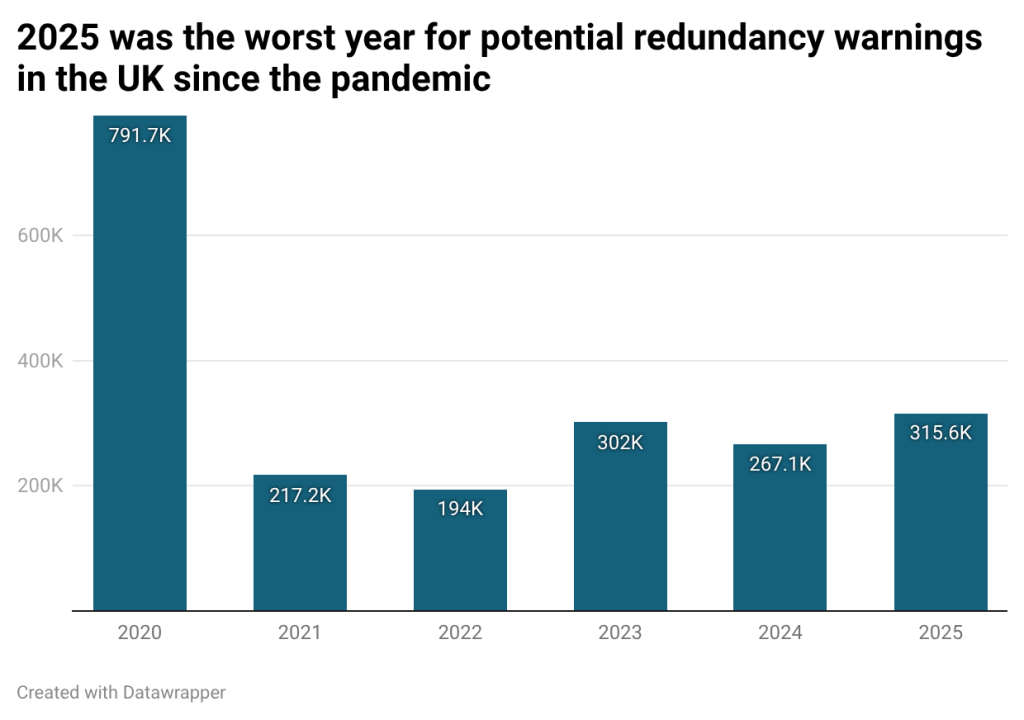
Now, new data sourced by the experts at Liquidation Centre has revealed that 2025 was the most severe year for redundancy warnings since 2020, with 315,605 jobs flagged for potential redundancy and redundancy payouts totalling £477,709,323 in 2025.
The experts at Liquidation Centre, a trusted UK liquidation firm focused on solvent liquidations (MVL), for contractors and small business owners, while also supporting Creditors’ Voluntary Liquidations (CVL) for insolvent businesses, sent a Freedom of Information request to the Insolvency Service to determine how many employers made or planned redundancies and the expected redundancy payout for proposed dismissals from 2020 to 2025.
Study highlights:
- 2025 was the worst year since COVID for redundancies, with 315,605 jobs flagged for potential redundancy with a combined payout of £477,709,323
- In the first two months of 2026, 736 employers have already filed for proposed redundancies, putting 56,396 jobs at risk of redundancy – 9% higher than in 2025
- The number of HR1 advance notice of redundancy forms issued in February 2026 (430) is almost identical to February 2009 (433), shortly before the recession peak
Over 2 million redundancy warnings were made between 2020 and 2025 (2,087,709), with June appearing as the worst month for redundancies in the UK
Redundancies rose by 45% between 2021 and 2025
Liquidation Centre’s Freedom of Information request uncovered that over 2 million redundancy warnings were issued between 2020 and 2025 (2,087,709), with 2025 the most severe year for redundancy warnings in the past five years. Last year, 315,605 jobs were flagged for potential redundancy, a 45% increase since 2021, with redundancy payouts totalling £477,709,323.
Redundancies already up 9% year-on-year in 2026
Because redundancy warnings are typically filed weeks or months before job losses take effect, the elevated figures seen in 2025 may persist into early 2026.
In the first two months of 2026, 736 employers filed for proposed redundancies, putting 56,396 jobs at risk of redundancy, compared to the first two months of 2025, which were 51,905 redundancy warnings, a 8.65% increase in warnings.
UK redundancy payouts near half a billion in 2025
| Month | Total HR1 Forms Received | Total Number of Potential Redundancies | Unique Number of Employers Submitting HR1 Forms | Gross Value of Redundancy Payments (£) |
|---|---|---|---|---|
| January | 387 | 23,199 | 327 | £40,259,812.40 |
| February | 420 | 28,706 | 363 | £34,442,879.91 |
| March | 477 | 31,825 | 387 | £42,540,317.92 |
| April | 365 | 23,769 | 312 | £41,487,098 |
| May | 382 | 24,643 | 328 | £33,244,843 |
| June | 414 | 32,428 | 334 | £37,410,232 |
| July | 407 | 25,162 | 318 | £36,011,031 |
| August | 285 | 23,436 | 240 | £36,342,589 |
| September | 345 | 24,504 | 294 | £37,536,786 |
| October | 412 | 25,461 | 334 | £45,811,145 |
| November | 412 | 30,396 | 337 | £37,060,417 |
| December | 248 | 22,076 | 221 | £55,562,172 |
| Total | 4,554 | 315,605 | 3,795 | £477,709,323 |
| January 26 | 396 | 28,493 | 356 | N/A |
| February 26 | 430 | 27,903 | 380 | N/A |
Full dataset available here.
The number of HR1 advance notice of redundancy forms issued in February 2026 (430) is almost identical to February 2009 (433), shortly before the peak of the 2008-2009 recession, highlighting the scale of pressure currently facing the UK labour market.
Using historical redundancy data, the experts at Liquidation Centre estimate that 2026 could see as many as 327,227 redundancies, with 11,622 more jobs lost than in 2025. This marks a forecasted 3.7% increase from 2025; however, this is less severe than that of 2024-2025, which saw an 18.1% increase in redundancies.
Richard Hunt, Director at Liquidation Centre, weighs in on why 2026 may be another record year for redundancies:
“Redundancies are happening at a rapid pace in the UK as the economy continues to change and industries adapt. including automation and AI. Unlike in 2020, when redundancies were largely driven by a single crisis, the rise in redundancy warnings in 2025 appears to reflect more ongoing pressures on employers. These include rising operating costs, wage inflation, and policy changes such as higher employer National Insurance contributions.
2026 is already shaping up to be an unfortunate record year for redundancies. Increased competition, cost of living, taxation, and wage inflation are all key contributing factors. Global political uncertainty often has a knock-on effect on businesses worldwide, and the UK is no exception. Disrupted trade and supply chains, rising operating costs, and poor business confidence are likely to add further strain for businesses.”
What are the biggest red flags that businesses are in trouble?
So, what red flags might suggest companies are headed for trouble, and how do you spot these signs early on? Richard Hunt, Director at Liquidation Centre, weighs in:
- 🚩Increase in cost of sales
- 🚩Unexpected staff departures or leadership changes
- 🚩The loss of a key customer or a delay in customer payments
“Spotting the warning signs early is crucial. A business that’s becoming increasingly reliant on loans or credit to stay afloat should see that as a serious sign that something needs to change. Missing payments to suppliers or experiencing pressure from creditors is another major concern.
Sales figures might still look reasonable on the surface, but even a gradual decline should trigger a closer look at your figures. Pressure from HMRC is another serious sign, whether it’s reminders, penalties, or formal warnings. If you’re receiving legal letters from creditors, like a CCJ, things have already escalated, and that’s the point when businesses often reach out to us in urgent need of help.”
If you’d like to republish this content, please provide a link to: https://liquidationcentre.co.uk/.
Liquidation Centre is a UK liquidation firm specialising in Members’ Voluntary Liquidations (MVL) for solvent companies, trusted by contractors, small and medium-sized business owners, and company directors across the UK. It also assists businesses with Creditors’ Voluntary Liquidations (CVL) when companies become insolvent and need to close in accordance with UK insolvency law.
Methodology:
- To gather data for this study, Liquidation Centre sent a Freedom of Information request to the Insolvency Service to determine how many employers made or planned redundancies and the expected redundancy payout for proposed dismissals from 2020 to 2025.
- The following questions were sent to the Insolvency Service:
- For the period 1 April 2024 to 31 March 2025, please provide the following, broken down by month:
- The total number of proposed dismissals notified
- The total number of employers submitting notifications
- The number of notifications involving 20 or more proposed redundancies
- The total estimated value (£) of redundancy payments expected to be paid, based on redundancy notifications or claims received during this period
- Only if held, the number of cases contributing to this total.
- For the period 1 April 2025 to the most recent date for which data is held, please provide the same information as outlined in Q1, broken down by month.
- The study is based solely on information provided directly by the Insolvency Service and the Redundancy Payments Office in response to the Freedom of Information request outlined above. No responsibility is assumed for any inaccuracies resulting from erroneous data provided by the bodies.
- All data is correct as of February 2026. Should any service wish to provide updated data, then they can do so by emailing: tori@journalistic.org outlining updates to the data and the reasons behind them.
Full dataset available here.
Note to editors:
[1] ONS | Unemployment