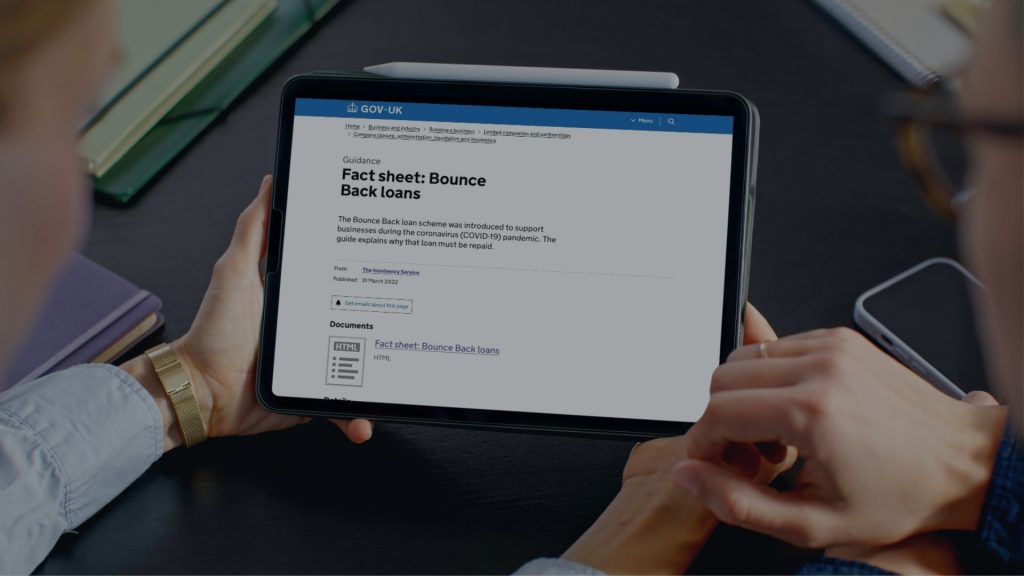
If your company cannot repay its Bounce Back Loan, you may be able to close the company through a formal liquidation process and have its remaining company debts dealt with as part of that process.
If you’re struggling to keep up with repayments and considering closing your company, you’ll want to know what happens to the Bounce Back Loan and what liquidation could mean for you as a director.
| Bounce Back Loan Scheme Details | |
|---|---|
| Launched | 4th May 2020 |
| Closed | 31st March 2021 |
| Loan size available | £2,000 to £50,000 (up to 25% of turnover) |
| Interest rate of loans | 2.5% |
| Government guarantee | 100%, given to the lender |
| Personal guarantee from directors | Not needed |
| Loan usage | Around 1.5 million businesses applied for the scheme, totalling £46.47 billion in loans |
This guide explains your options, how a Creditors’ Voluntary Liquidation (CVL) works, what happens to the outstanding loan and when you could be personally liable.
What is Bounce Back Loan liquidation?
When a company cannot repay its debts, including a Bounce Back Loan, a CVL may be an appropriate option to close the company and deal with the outstanding debts.
During the process, a licensed insolvency practitioner takes control of the company’s affairs, deals with creditors and investigates the circumstances that led to the insolvency.
If the company’s assets are insufficient to repay its debts in full, the Bounce Back Loan lender may receive only a partial repayment, or none at all. The unpaid balance does not automatically become the director’s personal debt simply because the company has failed; personal liability may arise however where there is a separate legal basis, such as misconduct in obtaining or using the loan.
The liquidator will investigate how the company was run, including how the Bounce Back Loan was obtained and used. If there has been misuse, false information or other misconduct, this can result in personal liability or other action against the director.
Can I liquidate my company with a Bounce Back Loan?
Having an unpaid Bounce Back Loan does not prevent you from liquidating your company. If your company is insolvent and cannot repay its debts, an outstanding Bounce Back Loan is seen as one of the company’s liabilities that needs to be dealt with during the insolvency process.
Directors in this position will usually ask the same three questions:
1. Will the Bounce Back Loan prevent the liquidation?
An unpaid Bounce Back Loan does not mean that you have to keep the company trading or repay the loan in full before you can liquidate. If the company is insolvent, then a Creditors’ Voluntary Liquidation may be the most appropriate route for you to consider.
2. Will the loan be treated as an unsecured creditor debt?
A Bounce Back Loan is unsecured, so the lender does not have security over the company’s assets. The lender will submit a claim to the liquidator, who will deal with it alongside the company’s other unsecured creditors. Once the insolvency practitioner has been appointed, they will deal with the Bounce Back Loan lender as part of the liquidation process, so you won’t need to negotiate with the lender yourself.
3. What happens to the remaining balance?
If the company does not have enough assets to repay the Bounce Back Loan in full, the remaining balance will normally be left unpaid at the end of the liquidation.
The Bounce Back Loan was backed by a 100% government guarantee to the lender, which means the lender can usually claim its loss from the government, rather than relying only on what the company can repay.
The government guarantee may compensate the lender for eligible losses, subject to the scheme’s terms. It does not cancel the company’s liability for the loan.
How does the government guarantee affect the Bounce Back Loan write-off?
The government guarantee may compensate the lender for eligible losses, but it does not write off the company’s loan liability. This means the company remains liable for the loan. If the company becomes insolvent and cannot repay the full amount, the lender can recover whatever is available through the liquidation.
Lenders were not permitted to take personal guarantees under the BBLS, so the lender cannot enforce a personal guarantee under the scheme against the director’s personal assets. However, the government guarantee does not protect a director from personal liability arising from their conduct.
As part of the liquidation, the liquidator investigates the company’s affairs, including how the Bounce Back Loan was obtained and used. If the investigation identifies evidence that the director supplied false information or used the funds for personal benefit, the liquidator may consider pursuing a claim against them.
How to liquidate a company with a Bounce Back Loan
Liquidating a company with a Bounce Back Loan follows the usual Creditors’ Voluntary Liquidation process:
Stage 1: Understand your options and take advice
If your company is struggling to pay its debts, getting advice early can help you understand your options and what you need to do next. As a director, your duties change when a company becomes insolvent, and you need to consider the interests of creditors.
Becoming insolvent does not necessarily mean the company must stop trading immediately. In some circumstances, continuing to trade for a short period may be appropriate if it is likely to achieve a better overall outcome for creditors and does not increase their losses.
However, this should be considered carefully with advice from a licensed insolvency practitioner, as continuing to trade when a company cannot pay its debts can increase losses and lead to questions about how the company was managed.
Stage 2: Appoint a licensed insolvency practitioner
Once you’ve decided that liquidation is appropriate, a licensed insolvency practitioner will guide you through the process.
Before the liquidation begins, the insolvency practitioner will review your company’s financial position, its assets and liabilities, and the circumstances that led to its insolvency. They will also need to understand the Bounce Back Loan, including the amount outstanding and how the funds were obtained and used.
Once the liquidator has been appointed, they will deal with the company’s creditors including the Bounce Back Loan lender, as part of the liquidation process.
Stage 3: Assets are sold and creditors are paid in order
The liquidator will identify the company’s assets and determine what can be realised for the benefit of creditors. This may include equipment, stock, vehicles, money in company bank accounts and unpaid invoices owed to the business.
The proceeds are then distributed according to the statutory order of priority. A Bounce Back Loan is an unsecured debt, so the lender ranks alongside the company’s other unsecured creditors rather than having security over the company’s assets.
Stage 4: The unpaid Bounce Back Loan balance is dealt with
The lender will submit a claim for the amount outstanding. If there is money available for unsecured creditors, the Bounce Back Loan lender will receive its share of the available funds.
If there is not enough money to repay the loan in full, the remaining balance will normally be left unpaid when the liquidation is completed. The lender may then make a claim under the government guarantee where the scheme conditions are met.
Stage 5: The company is dissolved
Once the liquidator has dealt with the company’s assets, creditor claims and statutory reporting requirements, the liquidation can be brought to an end. The company will ultimately be dissolved from the register at Companies House.
For a director who has acted properly, liquidation does not prevent them from becoming a director of another company or starting a new business.
What happens to a Bounce Back Loan if a company closes?
If you’re considering closing your company with a Bounce Back Loan still outstanding, the loan remains a debt of the company. If the company is insolvent and enters liquidation, the Bounce Back Loan will be dealt with as part of the insolvency process alongside the company’s other debts.
The lender will make a claim in the liquidation and may receive a share of any money recovered from the company’s assets. If the loan is not repaid in full, the lender may be able to recover its remaining eligible loss through the government’s Bounce Back Loan guarantee.
For a director who has used the loan properly and is not personally liable for the debt for any other reason, the outstanding balance will not become a personal debt after the company has entered liquidation
Does the Bounce Back Loan get written off when a company liquidates?
In most cases, if the company is insolvent and does not have enough assets to repay the Bounce Back Loan, the remaining balance will normally remain unpaid when the liquidation is completed
Because the loan is an unsecured company debt, the lender will make a claim in the liquidation and receive a distribution of the company assets where possible. If there aren’t enough assets to fully repay the lender, the lender may claim for eligible losses under the government guarantee, subject to the scheme’s terms and conditions.
An unpaid balance does not automatically become the director’s personal liability simply because the company has failed. Personal liability may arise if there is a separate legal basis, such as misconduct in obtaining or using the loan.
Can I dissolve my company instead of liquidating it?
If your company is insolvent and cannot repay its Bounce Back Loan, voluntary strike-off is not an alternative to formal insolvency proceedings and does not remove the debt.
During the application to dissolve a company, the creditors will be notified, and the Bounce Back Loan lender can object to the strike-off application. If an objection is made, the company may remain on the Companies House register and the debt will stay outstanding.
Dissolving a company does not necessarily prevent its affairs from being investigated. The Insolvency Service has powers to investigate the conduct of directors of dissolved companies, including in cases involving suspected Bounce Back Loan misuse. A creditor can also apply to have a dissolved company restored to the register in appropriate circumstances.
If the company is insolvent, a formal liquidation provides a proper process for dealing with its creditors and investigating its affairs. Our guide to dissolving a company explains when striking off a company is the right route for your business.
What is the Bounce Back Loan loophole?
The Bounce Back Loan ‘loophole’ is a term that has been used to describe gaps in the Bounce Back Loan Scheme rules. The scheme was set up quickly, personal guarantees were not permitted under the scheme and businesses could self-certify their turnover and eligibility, and lenders carried out limited checks before releasing the funds. This meant some businesses were able to overstate their turnover and borrow more than the 25% limit, while others used the money for purposes that were not permitted under the scheme.
However, there is no loophole that allows directors to avoid a Bounce Back Loan by closing their company. If your company is genuinely insolvent and cannot repay what it owes, a Creditors’ Voluntary Liquidation (CVL) may provide a formal way to close the company and deal with its outstanding debts.
A CVL does not remove a director’s responsibilities or prevent the company’s affairs from being investigated.
Are directors personally liable for a business Bounce Back Loan?
Many businesses applied for a Bounce Back Loan honestly and lawfully, and an unpaid loan does not automatically mean that the director has done anything wrong.
Personal guarantees were not permitted under the scheme so the loan is a debt of the company, not the director personally.
However, personal liability can arise in certain circumstances, where there has been misuse of the loan, false information was provided or other forms of misconduct. The liquidator has a duty to investigate the company’s affairs as part of the liquidation process.
Here are two examples of circumstances where a director could become personally liable:
Misuse of the Bounce Back Loan
If the loan was obtained using false or misleading information or funds were used for your personal benefit rather than for legitimate business purposes, the liquidator may seek to recover it from you personally.
Wrongful trading or misconduct
If you knew or ought to have concluded that there was no reasonable prospect of avoiding insolvent liquidation, and failed to take every step to minimise creditors’ losses, the liquidator may investigate a wrongful-trading claim and seek a contribution to the company’s assets.
What counts as misuse of a Bounce Back Loan?
Bounce Back Loan funds were intended to provide an “economic benefit” to the business. Misuse may include spending the funds for personal purposes or using them in a way that does not provide an economic benefit to the business.
The table below shows the difference between normal business spending and the kinds of payments a liquidator may treat as misuse.
| Normally legitimate business use | Potential misuse |
|---|---|
| Staff wages and salaries | Personal spending or paying personal debts |
| Rent and business premises costs | Buying personal assets with company funds |
| Stock and supplier payments | Transfers to a personal account with no genuine business reason |
| Equipment | Transfers to a connected company without a proper business purpose |
| Professional fees | Dividends paid without sufficient distributable profits |
Providing false information about turnover or eligibility, or deliberately obtaining more than one Bounce Back Loan, would also be treated as misuse.
If the liquidator finds evidence that Bounce Back Loan funds were misused, they will seek to recover the money personally from the director. The matter will also be reported to the Insolvency Service and could result in director disqualification, a compensation order or, in serious cases, criminal proceedings being instigated by the Insolvency Services.
Can a director be disqualified over a Bounce Back Loan?
Yes, a director can be disqualified over Bounce Back Loan misconduct, but an unpaid Bounce Back Loan in itself does not automatically result in disqualification.
Disqualification depends on a number of factors connected to how the director operated the business and its causes for failure, not just on whether the loan was repaid. As part of an insolvent liquidation, the liquidator reports on the conduct of the company’s directors to the Insolvency Service, and they may then investigate further.
If a director is disqualified, the period can range from two to fifteen years. During the period of disqualification, they cannot act as a director or become involved in the management of a company as this would breach the disqualification order.
For directors who used their Bounce Back Loan appropriately and whose business subsequently failed, the fact that the loan remains unpaid does not in itself mean that disqualification is likely.
What happens after Bounce Back Loan liquidation?
Once the liquidation has been completed, the company will be dissolved from the Companies House register after completion of the liquidation. If there is an outstanding Bounce Back Loan that could not be repaid from the company’s assets, the remaining balance will have been dealt with as part of the insolvency process.
For a director who has used the loan properly and has not been found personally liable for any other reason, “any unpaid balance does not automatically become the director’s personal debt
Liquidating a company does not normally prevent a director from becoming a director of another company or starting a new business, unless they’ve been disqualified or are subject to other restrictions. If the plan is to start a new company, there are restrictions to reusing the name of a liquidated company, or a name that is very similar, for five years from the date of liquidation to protect creditors from potential misuse.
If you were also an employee of the company and meet the relevant requirements, you may be able to claim redundancy pay, notice pay, holiday pay and certain unpaid wages from the National Insurance Fund. Eligibility depends on your circumstances, including your employment status and the length of your employment.
How the Liquidation Centre can help with your Bounce Back Loan liquidation
The Liquidation Centre offers expert advice and guidance to directors who are struggling to repay a Bounce Back Loan and are considering closing their company. Our in-house liquidation team has more than 20 years of experience helping directors through the insolvency process, and we’ll explain each step and your options clearly.
If your company cannot repay its Bounce Back Loan and other debts, we can explain your options and guide you through the liquidation process from the initial assessment through to company closure. We’ll explain what a Creditors’ Voluntary Liquidation could mean for your company and for you personally, including how the Bounce Back Loan is dealt with.
Our initial consultation is free and confidential, with no obligation to proceed. If you’re struggling with a Bounce Back Loan or want to close a company you no longer need, contact us today to talk through your situation.
Bounce Back Loan Liquidation FAQs
Can I start a new company after a Bounce Back Loan liquidation? ▸
In most cases, directors can start a new company after a Bounce Back Loan liquidation. An insolvent liquidation does not normally prevent you from starting another company or becoming a director again, unless a director has been disqualified or is otherwise legally restricted. See our guide to directors’ duties in an insolvent liquidation for more detail.
If you plan on starting a new company after liquidation, directors should be careful about reusing the same company name as the liquidated company. Section 216 of the Insolvency Act 1986 can restrict people who were directors or shadow directors during the 12 months before an insolvent liquidation from being involved in a company using a prohibited name for five years.
You may also be able to acquire assets from the liquidator to be used in a new company, but any transaction needs to be handled properly, and whether this is possible in your specific circumstances should be discussed with the liquidator.
What happens to a Bounce Back Loan if a company goes bust? ▸
If a company is insolvent and needs to close through a liquidation, the Bounce Back Loan is treated as an unsecured claim alongside the company’s other unsecured debts. It does not automatically become a personal debt of the director.
Where possible, the lender may receive a payment from the sale of the company’s assets, and may claim for eligible losses under the government guarantee, subject to the scheme’s terms.
Is there a Bounce Back Loan loophole? ▸
There is no loophole that removes a director’s personal liability for misconduct involving the misuse of a Bounce Back Loan. If the company is genuinely insolvent, a CVL provides a formal process for realising its assets and distributing the proceeds to creditors. Any balance left unpaid does not automatically become the director’s personal debt.
What happens if you don't pay back a Bounce Back Loan? ▸
If your company is still trading but you can’t pay the Bounce Back Loan repayments, the lender can take recovery action against the company. Defaulting on a Bounce Back Loan and then ignoring the debt could lead to a compulsory liquidation, where the decision to close will be taken out of your hands. Acting sooner and seeking advice about a CVL will usually give you more control over the outcome and will usually ease the pressure sooner.
Having an unpaid Bounce Back Loan does not usually mean you’ll be personally liable for the debt, but if there has been misuse or misconduct, you could be made personally liable. We can explain what this means, and the possible risks to you, when we talk through your situation and options.
If the company is insolvent, meaning it cannot repay its debts, speak to us to understand your options.