
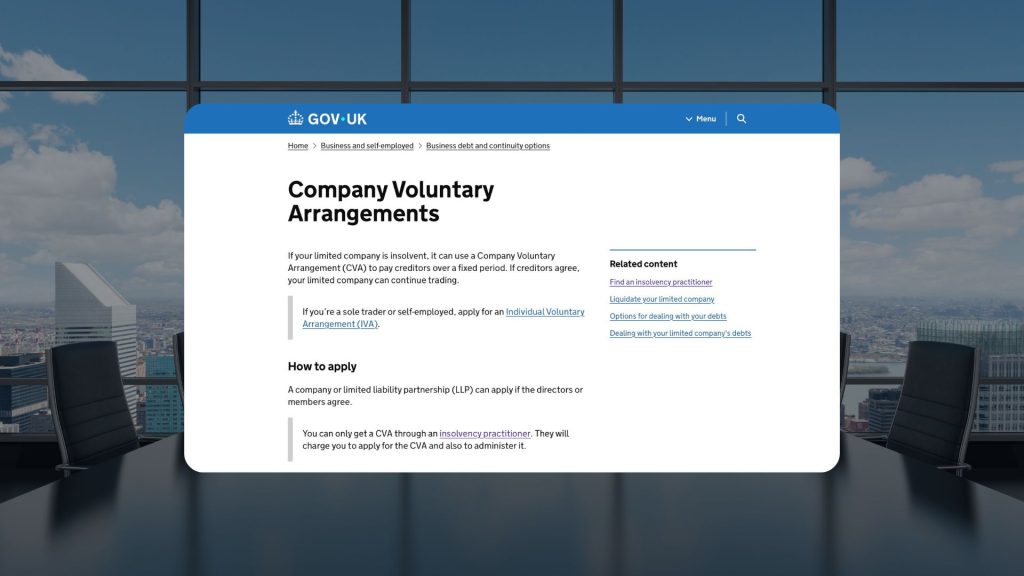
Company voluntary arrangement – explained
A CVA, or Company Voluntary Arrangement, is a formal insolvency procedure that gives a struggling business time to repay its debts over time while continuing to trade. If your company is dealing with unmanageable debt but still has a viable future, a CVA could help you to get back on track without having to close the business down.
What is a CVA?
A CVA is a legally binding agreement between your company and its creditors. You propose a repayment plan, and the CVA is only approved if creditors representing 75% by value of those who vote agree. If that threshold is not met, the company will need to consider alternative insolvency procedures such as a voluntary liquidation.
A CVA must be proposed and supervised by a licensed insolvency practitioner, and all payments to creditors are made through them throughout the process. The agreed repayment period is usually between three and five years, and the company continues to trade while repaying its debts. Directors remain in control of the business throughout, which is one of the main differences between a CVA and administration
How does a CVA work?
A CVA works by giving your company time to repay what it owes in a manageable way, rather than being forced into liquidation. A licensed insolvency practitioner looks at your finances, helps you put together a repayment proposal, and puts it to your creditors for a vote. If they approve it, the arrangement comes into force and you start making agreed repayments while continuing to trade.
The IP stays involved throughout as supervisor, making sure the terms of the arrangement are being met and keeping creditors updated on progress.
What is a CVA agreement?
A CVA agreement is the formal document that sets out what you have agreed to pay your creditors, including the payment period and conditions. Once it is approved, it is legally binding on all of the company’s unsecured creditors, even those who voted against it, as long as it reached the required 75% majority.
However, a CVA does not bind secured or preferential creditors without their consent, their agreement must be obtained separately.
How does a Company Voluntary Arrangement work?
The process of a CVA will usually look like this:
- The company works with a licensed insolvency practitioner which will assess its financial position and whether a CVA is viable
- The IP works with you to prepare a repayment proposal setting out how much creditors will receive and over what period
- The proposal is sent to creditors, who are normally given at least 14 days to consider and vote on it.
- If creditors holding 75% or more of the debt by value approve it, the CVA becomes legally binding
- Your company continues to trade while making the agreed repayments, with the IP supervising the arrangement
- Once all payments have been made and obligations met, the CVA is completed and your company carries on as normal
How to prepare for a CVA proposal?
Before a CVA proposal can be prepared, directors need to demonstrate that the CVA will provide creditors with a better financial outcome over other options, such as liquidation. You’ll need to gather clear financial evidence that proves your business can become viable and profitable and can cover day-to-day costs as well as the agreed repayments.
You will need to provide up to date management accounts, cash flow forecasts, and a clear explanation of what caused the financial difficulties and what you are doing to address them. Having this information and a well-prepared proposal will help to give creditors confidence that the arrangement is viable and represents a better return than the alternatives.
Advantages of a CVA
The main advantages of a CVA include:
- Your business carries on trading, so you keep your customers, staff, and contracts
- You stay in control of the business throughout the process
- It avoids having to close the company through liquidation
- Creditors often recover more than they would in a liquidation, which gives them a reason to support it
- Once approved, it is binding on all unsecured creditors, even those who voted against it. It does not however bind secured or preferential creditors without their consent.
- It can usually be done without any public court proceedings
Eligible companies may be able to obtain a moratorium to provide temporary protection from creditor action while the proposal is being prepared, though this is not automatic. Directors should also be aware that new creditors who extend credit after the arrangement is approved are not bound by the CVA and retain all their usual enforcement options, including the ability to present a winding-up petition for unpaid debts arising after the CVA commenced.
Company Voluntary Arrangement disadvantages
A CVA will not be the best route for every business, and the potential drawbacks should be discussed with an insolvency practitioner.
Drawback of a CVA include:
- A CVA goes on the public record, which some suppliers, customers, and lenders may pick up on You need approval from creditors representing 75% by value of those who vote, and that is not always guaranteed.
- You must keep up with repayments throughout as falling behind means the CVA can fail
- Secured creditors and preferential creditors are not bound by the arrangement and can still take action against the company
- It can make it harder to access credit or new finance while the arrangement is running
- If the business is not viable, a CVA only delay the inevitable outcome and increase the overall debt
Is your business suitable for a CVA?
A CVA is for businesses that are struggling with debt or short-term cash flow issues, but are otherwise viable.
If you still have regular customers, and your business is usually profit making , but you have been hit with large debts such as unpaid HMRC taxes or old supplier invoices, CVA can allow you to agree an affordable repayment plan with your creditors while allowing ongoing trading.
For a CVA to be viable, creditors will need to believe they will get more back through the arrangement than they would if the company went into liquidation.
A CVA may be suitable for your business if:
- Your business has regular income and a genuine customer base
- The financial problems stem from a specific debt (like an unexpected HMRC bill) or a difficult trading or cash-flow period, rather than the business model itself being fundamentally unviable.
- You have addressed, or have a clear plan to address, what caused the debt in the first place
- Creditors are likely to recover more through a CVA than they would through liquidation
If the business can no longer trade profitably, a CVA will not be an appropriate route. In that case, administration or a CVL may be the better option.
What is the CVA procedure?
To start a CVA, you need to instruct an insolvency practitioner. They will look at your finances, work with you to put together a repayment proposal, and put it to your creditors for a vote. If it is approved, the IP will supervise the repayments throughout the agreed period, making sure the terms are being met and keeping creditors informed in line with the terms of the Arrangement.
What happens if my CVA is rejected?
If creditors vote against the proposal, the CVA cannot go ahead. You’ll then need to explore alternative routes with your insolvency practitioner. In some cases it may be possible to go back to creditors with a revised proposal. If not, administration or a Creditors’ Voluntary Liquidation may be the appropriate choice depending on your circumstances.
The difference between CVA and administration
Both a CVA and administration are designed to rescue a business rather than close it, but they work in very different ways.
In a CVA, you stay in control of your business and it carries on trading normally while you repay creditors under the agreed arrangement. It is less disruptive and generally less expensive than administration.
In administration, an administrator takes over control of the company. Their job is to pursue one of three statutory objectives: rescuing the company as a going concern, achieving a better result for creditors than an immediate liquidation, or realising assets to make a distribution to secured or preferential creditors. It offers stronger legal protection from creditor action, but you hand over control of the business and costs tend to be higher.
Administration can only be used if it can achieve one of the listed objectives. A CVA can sometimes be used alongside administration or as a follow-on from it as part of a wider rescue plan.
The right choice depends on your specific situation, how much time you have, and what your creditors are likely to support. Speaking to a licensed insolvency practitioner is the best way to find out your options.
How the Liquidation Centre can help
At the Liquidation Centre, we work with businesses across the UK that are under financial pressure and trying to understand their options. Our licensed insolvency practitioners can tell you whether a CVA is possible for your situation, or whether a different route like a CVL or Administration would be more appropriate.
We offer a free, confidential consultation with no obligation. Get in touch today to talk through your options.
CVA FAQs
What happens if a CVA fails? ▸
If you fall behind on your CVA repayments or breach the terms of the arrangement, the supervisor can end it, and in most cases, will petition for the company’s winding up.
Creditors also regain the right to take action against the company, which could also result in compulsory liquidation. What happens to the outstanding debt depends on the terms of the arrangement, but in most cases creditors’ claims revert to the full original amounts less any payments already made.
How long does a CVA last? ▸
Most CVAs run for three to five years, depending on what was agreed with creditors. Shorter arrangements are possible if you can repay creditors more quickly. The CVA ends once all agreed payments have been made and the supervisor confirms the arrangement is complete.
Will HMRC accept a CVA? ▸
HMRC is often one of the biggest creditors in a CVA, usually if the company has fallen behind on paying tax bills. HMRC can and does accept CVA proposals, but it will look carefully at whether the business is genuinely viable and whether the proposed repayments are realistic.
HMRC will also consider the company’s tax compliance history, including whether returns have been filed on time and how previous arrears were handled. A company with a poor compliance record will find it harder to gain HMRC’s support.
What is a voluntary arrangement on Companies House? ▸
When a CVA is approved, it is registered at Companies House and shows on the public record. This means suppliers, customers, and lenders can see that your company is subject to a voluntary arrangement.
Once the CVA has been successfully completed, the company’s status is updated, although the filing history remains on the record.
What is a CVA insolvency? ▸
CVA insolvency simply refers to a Company Voluntary Arrangement being used as a formal insolvency procedure.
Rather than closing the business, it gives the company a structured way to repay its debts over time while continuing to trade.
What does a CVA mean for employees? ▸
If a CVA involves restructuring, for example making redundancies or changing employees’ terms and conditions, employees have legal protections. Redundancies may trigger consultation requirements, and changes to terms and conditions generally require employee agreement.
If the CVA is not successful and the company goes into liquidation, employees may be eligible to make certain claims for unpaid wages, holiday pay, and notice pay through the Redundancy Payments Service.