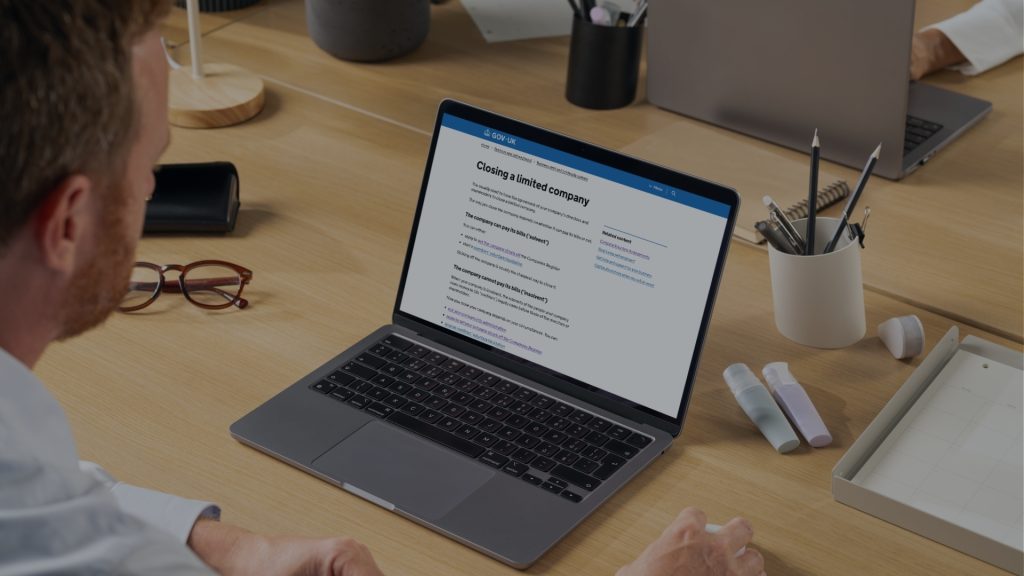
Closing your limited company involves ending it as a legal entity, stopping all business operations, and removing it from the official government records at Companies House. After that, the company no longer exists, so it cannot trade, sign contracts, or own assets.
How you close your limited company depends on whether your business is solvent (it can pay its debts) or insolvent (it owes more money than it can afford). Follow the correct procedures to fulfil your obligations as a director and avoid legal implications later.
Here at the Liquidation Centre, we can provide guidance on:
- How to close a limited company (with and without debts).
- How to close a dormant company.
- What happens to your assets when you close a limited company.
We can also discuss alternatives to closing your company and whether there are other ways to close your business than liquidation, such as a voluntary strike off (dissolution).
How to close a limited company: Which route is right for you?
Choosing the right route for closing a limited company depends entirely on whether your business is solvent or insolvent. In other words, whether it can pay its bills and debts as they fall due.
- If the answer is no, your company is insolvent, and the usual route to close it down is Creditors’ Voluntary Liquidation (CVL).
- If the business still has a viable future, then a Company Voluntary Arrangement (CVA) or administration may be possible.
- If you do not seek advice promptly when the company is showing signs of insolvency, then a creditor can petition the court and force the company into Compulsory Liquidation.
But if the answer is yes, then your company is solvent, and your options for shutting down your company are:
- Strike off (dissolution)
- Members’ Voluntary Liquidation (MVL)
Whichever route you take when closing a company, all are designed to ensure the official winding-up of your business.
How to close a limited company with debts
To close a limited company with debts, you’ll need to use a formal insolvency process. In most cases, this is a Creditors’ Voluntary Liquidation (CVL).
Creditors’ Voluntary Liquidation (CVL): Closing an insolvent company
When closing an insolvent company, you’ll likely need the assistance of a licensed insolvency practitioner (IP). This ensures the process follows the necessary legal requirements. Closing your insolvent business may seem daunting. But with the help of an IP, you’re able to start the CVL process, providing you with a structured way to wind down your insolvent limited company.
Ignoring the problems of an insolvent company will not make them go away. In fact, it can often make the situation much worse. As a director of an insolvent company, you have legal responsibilities you must fulfil. Failure to do so could result in serious consequences, such as:
- Being held personally liable for company debt.
- Being ordered to pay damages or compensation.
- Pre-liquidation transactions being challenged and potentially overturned.
- Loss of position.
- Director disqualification.
- Fines.
- Imprisonment.
Seeking advice from a licensed IP provides peace of mind that your insolvent limited company will close correctly and in line with these regulations.
The Liquidation Centre offers free, no-obligation financial health checks for limited companies like yours. Contact us today for more information.
Closing a limited company with debts to HMRC
If you want to close a limited company with debts to HMRC, then you must use a formal insolvency process, like a Creditors’ Voluntary Liquidation (CVL). In this situation, trying to remove your business from the Companies House register won’t work, as HMRC will reject the strike-off application.
The correct process is to follow the CVL process.
- Stop trading immediately to prevent further debt. Any decisions you make going forward must be in the best interests of your creditors, not you or the shareholders.
- Appoint a licensed insolvency practitioner. Only a licensed IP can act as liquidator, so this is required by law.
- The liquidator will sell company assets to repay creditors where possible. Once the company is dissolved, any unsecured debts that could not be repaid will be written off, unless you have signed a personal guarantee, which will need to be paid by you.
For more information, check out our guide on HMRC debt and liquidation.
Closing a limited company with a Bounce Back Loan (BBL)
You can close a limited company with an outstanding Bounce Back Loan (BBL), but you can’t dissolve or strike off your business. This is because a BBL is classed as an unpaid company liability, and lenders or HMRC will block attempts to dissolve a company.
The correct legal process for closing a limited company with a BBL is a Creditors’ Voluntary Liquidation (CVL) managed by a licensed insolvency practitioner.
As BBLs are backed 100% by the government, any remaining loan balance is written off once the liquidation process is complete and your company is dissolved. At this point, the bank claims the guarantee.
If you spent the loan on legitimate business expenses (such as wages, rent, or company assets) and followed the associated rules, then you’re not normally personally liable for the debt. However, if not, you could be personally responsible for repaying the money.
How to close a limited company with no debts
If you want to close your limited company and it has no debts (i.e., it’s declared solvent), then there are two ways in which you can wind the business down:
- Strike off (dissolution)
The cheapest way to close down a solvent limited company is to apply for a dissolution from Companies House. If your company has limited assets, this can be a cost-effective way to close down. To do this, your company must not have traded, sold stock, disposed of property for value, or changed its name in the last three months. It must also not be subject to any insolvency proceedings or an agreement with creditors, such as a CVA.
- Members’ Voluntary Liquidation (MVL)
If your company has a larger amount of assets, it may be better to close it through a Members’ Voluntary Liquidation (MVL).
An insolvency practitioner must be appointed to liquidate all company assets and distribute the net proceeds fairly across all shareholders.
An MVL could save you thousands in tax. Money paid out through an MVL is treated as a capital distribution rather than a dividend, so eligible shareholders may be able to claim Business Asset Disposal Relief (BADR) and pay just 18% on qualifying gains, up to a £1 million lifetime allowance. BADR isn’t automatic and must be claimed.
Conditions apply, so discuss whether you qualify with your accountant, as we can’t advise on your eligibility.
If you’re the director and shareholder of a solvent company and want to understand more about BADR and closing your company, check out our guide on what happens when a company goes into liquidation.
What is the dissolution of a company?
Dissolution of a company is the formal legal process of closing a company and removing its name from the official register at Companies House. After this point, the business ceases to exist as a legal entity, and it can no longer trade or sign contracts.
How to close a limited company that has never traded
You can close a company that’s never traded by applying for a voluntary strike off (dissolution) through the UK government website. As the company has never traded, it shouldn’t have any assets, debts, or employees, which should make the process straightforward.
Before applying for a strike off, you should make sure that the company has not:
- Traded or sold any stock in the last three months.
- Changed its name in the last three months.
- Faced the threat of liquidation or legal action.
- Entered into legal agreements with creditors.
If any of the above are not the case, then you cannot apply to strike off your company.
How to close a dormant company
To close a dormant company that has no outstanding debts or trading activity, you can apply for a voluntary strike off by submitting a DS01 form.
For this, you should:
- Check that the company has no debt, liabilities, or unresolved legal claims.
- Shut down any associated business bank accounts and settle any debts, including final administrative fees.
- Notify HMRC that your company is being closed and submit your final tax returns.
- Tell all shareholders, creditors, employees, and directors about the strike-off application within seven days of applying.
- Submit the DS01 form.
- Wait for Companies House to process your application and publish a notice in the Gazette (provided no objections are raised).
How to close a solvent limited company with assets
To close a solvent limited company with assets, you can choose between the following:
- Company strike off (dissolution) if the total you plan to distribute to shareholders is £25,000 or less.
- Members’ Voluntary Liquidation (MVL) for assets worth more than £25,000.
By choosing a company strike off, you:
- Shouldn’t trade, change the company name, or sell stock for at least three months.
- Must settle all liabilities, including paying off creditors, staff wages, and final tax bills.
- Should distribute any remaining assets or cash equally among shareholders.
- Complete a DS01 form and submit your application to Companies House.
Should you opt for an MVL, then you’ll need to:
- Sign a declaration of solvency confirming the company can pay all its debts (with interest) within 12 months. Where there are one or two directors, all must sign this. When there are more than two, a majority must sign.
- Hire a licensed insolvency practitioner to manage the sale of assets, clear any final debts, and distribute funds equally between all shareholders. They’ll also handle notices in The Gazette and the final removal of your business from the Companies House register.
Whichever option you choose is largely determined by the value of your company’s assets and retained profits.
What happens to assets when you close a limited company?
When you close a limited company, what happens to its assets depends on the business’s financial circumstances and whether it can pay its debts or owes money it cannot afford to pay. In other words, whether it is solvent or insolvent. All remaining assets must be cleared, sold, or distributed between shareholders and creditors before the business is removed from the Companies House register.
What is the cheapest way to close a limited company?
The cheapest way to close a limited company is a voluntary strike-off (dissolution), which costs £13 when submitted online through the UK Government’s Strike Off Service. However, this option is only available if your business is solvent (has no debts and can pay all final bills). If not, you’ll need to explore alternative options, such as Creditors’ Voluntary Liquidation (CVL).
How to close a company on Companies House
To close a UK company on Companies House, you need to apply for a voluntary strike off by submitting a DS01 form. However, you must declare your company solvent (i.e., able to pay its bills and any outstanding debts).
To do this, you must:
- Check your eligibility (not traded or changed names within three months and not facing liquidation or a Company Voluntary Arrangement (CVA).
- Wrap up business activity by stopping all trading and business operations, paying any outstanding bills, closing your business bank accounts, and dealing with any company assets.
- Inform any interested parties of your DS01 application by sending them a copy within seven days of submitting the form.
- File final tax returns and send final company accounts to HMRC, pay any remaining tax, and cancel your VAT registration.
- Submit the DS01 application.
Provided there are no objections, Companies House will remove your business from their official register. This process typically takes two to three months from when they accept the application to final dissolution.
What if I’m not ready to close my limited company?
Suppose you’re not ready to take the final step to close down your solvent limited company permanently, but you’re not in a position to trade at present. Or maybe you’d like to pause activity for the time being and come back to the business further down the line. Then, you could consider making the company dormant instead of dissolving it.
This will give you some time to think about your next steps and how you’d like to handle the business going forward.
A dormant company has no significant accounting transactions or trading activity during a set financial period. There is no time limit on how long your company can stay dormant.
This option is free, but you must:
- Cease all trading and business operations (including sales and any form of income generation).
- Make HMRC aware that your company is dormant for corporation tax purposes.
- Cancel any schemes, such as active PAYE payroll and VAT registration.
- File annual dormant company accounts and other notices as normal during the dormant period.
How the Liquidation Centre can help you close your limited company
The Liquidation Centre offers expert liquidation advice and guidance for both solvent and insolvent companies, particularly for those wanting to close their company down. Our in-house liquidation team have years of experience in keeping the process as simple and understandable as possible. If you’re facing creditor pressure, or you simply want to close a business you no longer need or want, contact us today to see how we can help you shut your company down as efficiently as possible.
FAQs on closing a limited company
Can I close my limited company and open a new one? ▸
Yes, you can legally close your limited company and open a new one, but you should be aware of some restrictions. If the old company went through an insolvent liquidation, section 216 of the Insolvency Act restricts you from using the same or a similar name for the new company for five years. Breaching this is a criminal offence and can make you personally liable for the new company’s debts.
Speak to an insolvency practitioner and your accountant before setting up a new company to talk through your options.
What tax do you pay when closing a limited company? ▸
When closing a solvent limited company, you must settle any final corporation tax payments on profits up to the date your company no longer exists. How this is done depends on the payout amount. For example, distributions totalling £25,000 or less are treated under Capital Gains Tax (CGT). If the total goes over £25,000, the whole amount is taxed as income rather than just the excess, unless you close the company through a formal Members’ Voluntary Liquidation.
How much does it cost to close a limited company? ▸
The cost to close a limited company varies depending on whether your company is solvent and can settle its debts or insolvent and cannot. It also depends on your business’s financial complexity, the method you choose to close your company, and how much specialist help you need to complete the process.
Here is a list of closure methods and their estimated costs:
Voluntary strike off (ranges from £13 for an online application and £18 for a paper application).
Members’ Voluntary Liquidation (MVL) (£1,499 – £4,000+).
Creditors’ Voluntary Liquidation (CVL) (£4,000 – £6,000+).
Compulsory Liquidation (HMRC Liquidation)
Do you need an accountant to close a limited company? ▸
No, you don’t legally need an accountant to close a limited company if using a voluntary strike off. But you must ensure you handle all financial duties correctly. You can do this yourself, or you can enlist an accountant for added peace of mind. If you’re going through a formal liquidation process, such as an MVL or CVL, then an accountant cannot legally complete this for you. Instead, you must appoint a licensed insolvency practitioner to complete the application and handle all finances.